
Bloodroot (Sanguinaria canadensis)
Sherman, Connecticut Forest
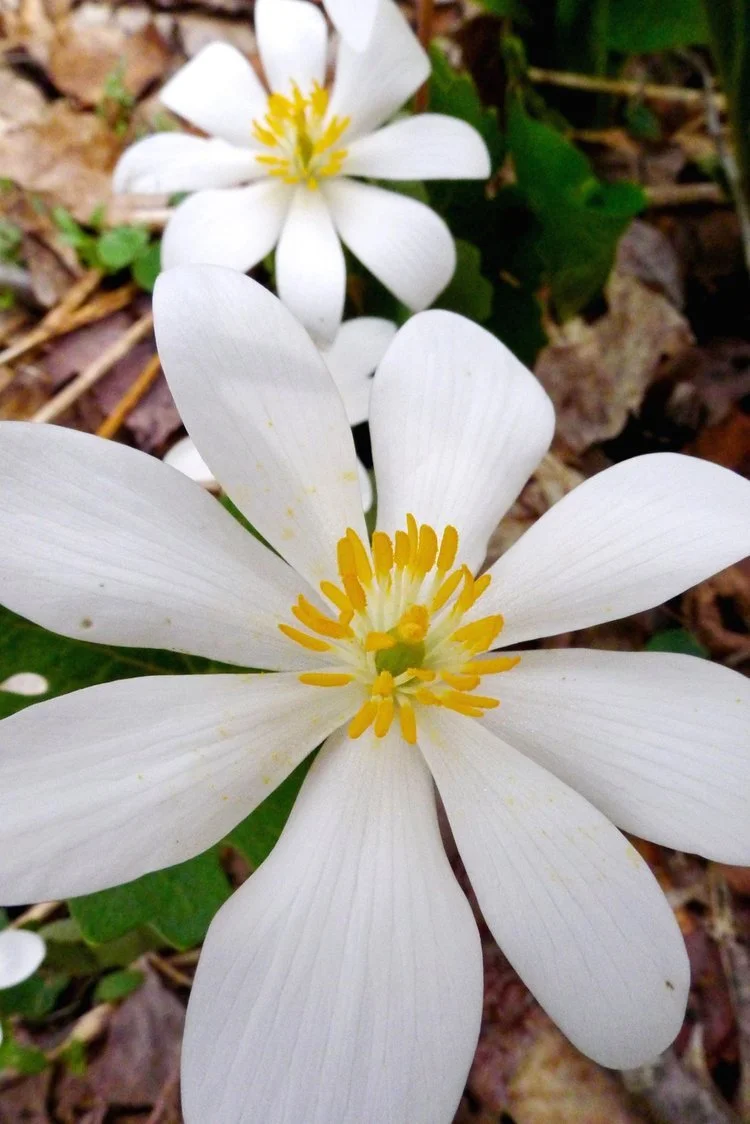
Bloodroot
(Sanguinaria canadensis)
Bloodroot is a captivating wildflower native to Eastern North America, known for its striking beautiful white blooms, softly scalloped leaves, and vivid red-orange sap. It is a spring ephemeral of the eastern woodlands, emerging early in the season while sunlight still reaches the forest floor.
Before the trees leaf out and the canopy closes, bloodroot briefly unfurls its delicate flowers, completing most of its aboveground life in just a few short weeks. Each plant produces a single flower wrapped within a single leaf, a distinctive growth pattern that protects the bloom during early spring frosts. This brief emergence is an essential part of bloodroot’s ecology and contributes to its reputation as a plant that appears, offers its presence, and then it retreats. Ephemeral. <3
When the underground rhizome is cut, a deep red sap is released almost immediately. This sap contains the alkaloid sanguinarine, a biologically active compound responsible for both bloodroot’s historical use and its risks. Sanguinarine is poisonous in high doses. The vivid color of the sap serves as a visible indicator of the plant’s potency; something that has shaped how humans have related to it for centuries.
Encountering bloodroot in the spring woods invites careful observation perhaps awe, reminding us that not all plants are meant for frequent use, but all have something to teach.
It is important to approach its harvest or therapeutic use of this sacred plant with caution and respect. As a native plant, bloodroot is threatened by overharvesting, making it crucial to protect and conserve this species.
History
Bloodroot was known to and worked with by several Indigenous Nations, including the Cherokee, Haudenosaunee (Iroquois Confederacy), Lenape (Delaware), Ojibwe (Anishinaabe), Potawatomi, and Meskwaki (Fox).
Daniel Moerman - Native American Medicinal Plants: An Ethnobotanical Dictionary.
Within these nations, bloodroot was treated as a powerful and respected ally. The red sap was used as a ceremonial and material dye, for basketry, textiles, and body paint, and sometimes in spiritual or protective contexts.
Medicinal use was limited, highly controlled, and embedded in lineage-based knowledge systems that emphasized caution and respect.
Bloodroot was recognized as a plant that commands respect. Its beauty and chemistry seen as inseparable, offering a clear example of how plants can be both visually striking and biologically powerful.
This is a plant has long been revered as well and understood as one that marks thresholds between winter and spring, medicine and poison, reverence and restraint.
Potency and Dangers of Bloodroot
Bloodroot contains the alkaloid sanguinarine, which accounts for both its historical interest and its dangers.
Sanguinarine is a naturally occurring benzophenanthridine alkaloid found primarily in bloodroot (Sanguinaria canadensis), as well as a few related plants in the poppy family (Papaveraceae). It is most concentrated in the rhizome and sap, where it gives bloodroot its characteristic deep red color.
Sanguinarine is biologically active and cytotoxic, meaning it can damage or kill living cells. This effect is dose-dependent, which is why it historically drew interest as a therapeutic agent
And why it is now approached with caution.
At the cellular level, sanguinarine can interferes with cell membranes, Disrupt mitochondrial function, Can trigger cell death (apoptosis or necrosis), Acts as a strong irritant to skin and mucous membranes, These actions are non-selective. Sanguinarine does not distinguish between healthy and diseased tissue.
Today, for safety and because bloodroot is endangered, it may be best to approach it as a plant of study, memory, and moral clarity rather than a home remedy. Do take note many bloodroot Black Salves made with Bloodroot are available in the marketplace, and people must exercise extreme caution working with these.
Its legacy reminds us that strength in the plant world is not an invitation to use for ourselves, but a call to listen.
In herbal medicine, it should treated with caution and respect. This is not a plant to be exploited or used recklessly, as improper harvesting or preparation can be harmful to slow growing stands of plants. Ethical and sustainable practices, such as sourcing from cultivated plants or supporting responsible wild harvesting, are essential to ensure that bloodroot remains available for future generations while preserving its natural habitats.
Some plants offer medicine.
Others offer boundaries.
Bloodroot offers both if approached with humility.
.Safety Note:
Bloodroot should be approached with caution due to its toxic constituents. Always consult a healthcare professional before using this plant medicinally, and never ingest it without proper guidance. Overuse or misuse can result in serious health complications and an endangerment to Bloodroot’s scarce native habitat.
To learn more about protecting bloodroot and other at‑risk native medicinal plants, you can visit United Plant Savers, a nonprofit dedicated to conserving native medicinal plants of the United States and Canada and their habitats while ensuring an abundant, renewable supply for generations to come.
Reference:
Foster, S., & Duke, J. A. (2000). Peterson Field Guide to Medicinal Plants and Herbs of Eastern and Central North America. Houghton Mifflin Harcourt.
Bear, Sun, and Wabun. The Medicine Wheel: Earth Astrology. New York: HarperOne, 1994.
Chevallier, Andrew. The Encyclopedia of Medicinal Plants: A Practical Reference Guide to the Medicinal Uses of Plants.New York: DK Publishing, 1996.
Hutchens, Alma R. Indian Herbology of North America. Boston: Shambhala, 1989.
Moerman, Daniel E. Native American Medicinal Plants: An Ethnobotanical Dictionary. Portland, OR: Timber Press, 2003.